Friday, January 21, 2011

Otepää Check-In

Tomorrow the World Cup visits Otepää, Estonia, one of the traditional stops on the circuit. The Otepää races are almost always classic individual-start events - as old school as it gets - and this year is no different. The Otepää races are also the venue at which Estonian racers tend to do well, for whatever reason. Last year, Jaak Mae took third and Andrus Veerpalu took second behind Lukas Bauer. (The rest of the top ten was completely Russian and Norwegian.) Neither Mae or Veerpalu had made a top-level podium for a while before that race (Veerpalu: first in the 15km classic at the Liberec Worlds; Mae: second at Otepää in 2008), and neither has done it since. Just as I had my doubts about the origins of their surprise placings last year, I have my doubts that either will finish in the money tomorrow. I suppose one should never doubt the magical water at the Tehvandi Sports Complex!


Checking on Veerpalu and Mae in the FIS database, it struck me that Estonia is oddly akin to Italy and Germany, two far more broadly successful ski-racing countries, in having very few distance-race podium finishes from its men in recent years. EST is a small country, of course, which makes the recent GER and ITA lapses all the more surprising - a point I made in a slightly different context last month. Looking at distance races...

1. Who was the last German male to reach a World Cup podium (i.e., not the Worlds or Olympics), and when?

2. Who was the last German male to win a World Cup race (i.e., not the Worlds or Olympics), and when?

3. Who was the last Italian male to reach a World Cup podium (i.e., not the Worlds or Olympics), and when?

4. Who was the last Italian male to win a World Cup race (i.e., not the Worlds or Olympics), and when?

ANSWERS
1. The last German podium finish was Tobias Angerer's second place in the 10+10km pursuit in the Falun season finale in March 2010. (Honestly, though, Angerer and Axel Teichmann did well at the Olympics, with the latter winning a silver in the 50km classic mass start and the two of them winning a silver in the team sprint.)

2. The last German win was Axel Teichmann's first place in the 3.3km prologue in the Falun finale in March 2009. Looking at real distance races, the last win was Angerer's first in the 15km mass-start skate race at Rybinsk on January 30, 2009.

3. The last Italian podium finish was Pietro Piller Cottrer's second place in the freestyle 50k at Holmenkollen in March 2010. (He had won a silver in the 15km skate race at the Olympics in the previous month.)

4. The last Italian win was Giorgio di Centa's first place in the Canmore 15km skate race in February 2010. (Piller Cottrer finished second in that same race.)

Though I guess some of these gaps aren't that long (ten months since Angerer's second place, eleven since di Centa's win), some are - almost two years since a German victory! And all of these finishes happened in markedly weak or otherwise odd races: the prologue is a weird event, and the fields were notoriously weak at Rybinsk and Canmore. (Obviously, the good Olympic results for Teichmann, Angerer, and Piller Cottrer are counterpoints.) If the Italian and/or German men rip it up at Otepaa tomorrow, I'll be as surprised as I won't be if Veerpalu uncorks a podium finish. My picks:

Tuesday, January 18, 2011

Bibs and Boards (Liberec Edition)

The "sprint weekend" on the world championship courses at Liberec saw Kikkan Randall win the individual skate event and Bjørgen return to form with a ridiculously easy win in the classic team sprint. The bibs were simple little numbers:


Kajot is a "gaming" company in the Czech Republic - it makes slot machines. Hence the clever substitution of lucky number seven for the J in the name - not that you'd have obtained good odds against Hattestad winning in bib #13.

Monday, January 3, 2011

Johan Olsson, Derider of Golf

Quoth Johan after today's 2x10 pursuit at the Tour de Ski, in which he finished 18th, "Det är en parodi att åka omkring på en golfbana när det finns så mycket fina berg att köra i.

According to Google Translate, this means, "It is a travesty to go around on a golf course when there are so very nice mountain running in."

According to the human who is behind World of XC and who knows English and Swedish, Olsson said,"It is a parody to race on a golf course when there are great mountains all around!"


I might more liberally translate Olsson as saying "Pursuits are easier when I have Marcus and Anders running interference behind me," and/or "In Sweden we play golf on terrain that's much rougher than this."

Sunday, January 2, 2011

Man-Crush on Kersh


The first three stages of the 2011 Tour de Ski have forced me to finally admit, to myself and to the Nordic Commentary Project's vast global readership, that I have a giant man-crush on Devon Kershaw. Lest you judge me, I offer a defense of my stance on the man who is now solidly established as North America's best male cross-country ski racer.

First and foremost, he's fast as hell. His results at the Vancouver Olympics didn't quite garner a medal, but c'mon: fourth in the team sprint and that heartbreaking fifth in the 50? Awesome. Kershaw has been consistently improving his World Cup results for a couple years now, with nine top-10 finishes between 2006 and 2009, but has this season made a big jump up. So far,, he's taken four top 10s: 10th overall in the Kuusamo mini-tour, 9th in the Davos 15k classic, and now the amazing back-to-back second places at the Tour de Ski, behind only Dario Cologna in the 15km classic pursuit and Emil Jönsson in the classic sprint. Great, great stuff that bodes well for the short term (a good TdS result), the middle term (the Oslo World Championships), and the long term (the 2014 Olympic Games).

Second, "Kersh" seems like a pretty cool guy. On his entertaining Twitter stream, his (oh-so-infrequently-updated) blog, and elsewhere, he talks frankly about the ups and downs of racing (his account of that Olympic 50 was moving), about his own development as a racer (including the almost-indescribable tragedy that he faced as a junior), and about life as a top-level athlete. He's got a great, loose writing style that's very natural and appealing - and which makes his racing all the more notable. It shouldn't be a surprise to me that there's a brain under that Cross Country Canada headband, but it's nice to see it frequently confirmed.


In short: Go Kershaw, go! I can't wait to see how the rest of the Tour and the rest of the season go.

Wednesday, December 29, 2010

How Bad Are the German and Italian Men?

Pretty bad.

Through nine individual events in this World Championships season, the Italian and German distance-racing men are really stinking it up. I dunno what the nordic-skiing communities in either country are saying about this, but I'd wager it isn't good: Worlds are only two months away.

In the head-to-head matchup of dismal distance teams, the German men have a slight advantage. Thanks to a sixth-place finish in the 10km classic race in Kuusamo, Filbrich ranks 21st in the WC overall. The young Tscharnke is in 23rd, just a few points behind. After that, though, it's a long way down to Teichmann in 46th (on the strength of a 5th in that Kuusamo classic event) and even further to Goring and Angerer in 57th and 58th - so far from the Red Group, they're only faintly pink. And none of the German sprinters - er, the German sprinter, Wenzl - have scored meaningful points.

So far, the best Italian men's finish is Scola's second in the Dusseldorf skate sprint. Ranked 12th in the overall, Scola also finished fourth in the Davos skate sprint, to go along with two twenty-something finishes earlier in the season. The only other Italian man in the top 30 of the World Cup overall is another sprinter, Renato Pasini, in 25th; his best is a fifth in the Kuusamo classic sprint. The once-vaunted Italian distance skiers are nowhere to be seen: di Centa is 39th, on just three point-scoring races (two 15ths and a 22nd), Hofer is in 49th, Piller-Cottrer is in 67th, Checchi is in 68th, and Clara is in 85th.

Counterpose these dismal accomplishments first to the respective teams' female racers: Germany has two women in the overall top 20 (Fessel in 5th and Zeller in 20th) while Italy has two in the top 10 (Follis, 3rd; Longa, 6th), one more in 30th (Genuin), and some promising skiing from Rupil, ranked only 44th but holding a 9th in the La Clusaz skate race.

Counterpose the men's results next to their early-season results last year. By the Christmas break in 2009, Teichmann had a 7th place in the Kuusamo classic race, di Centa had finished 4th and Filbrich 5th in the classic mass-start at Rogla, and Angerer had garnered a shock 2nd in the classic sprint at the same venue. Even Piller-Cottrer had an 11th, a 10th, and a 9th to his name.

What to make of all this? At the very least, it bodes poorly for good German or Italian results at Oslo, either individually or in the relay. In the latter discipline, the Germans' and Italians' weakness means that the track is clearer for Sweden and Russia, for Norway (not an untroubled men's squad), and even for outliers like Finland, Switzerland (winners of the La Clusaz relay) and the Czech Republic (with their bronze at Vancouver).

Tuesday, December 28, 2010

Bibs and Boards: La Clusaz

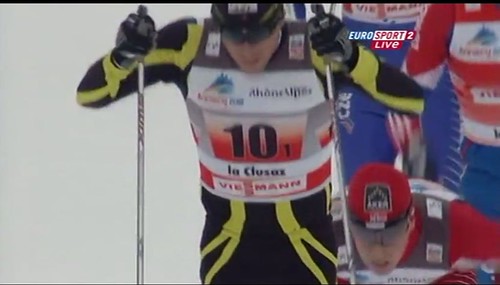
I've got lots to say about the last races and the upcoming ones, but no time to say it. Until I do, here's a cheap post - a bad screen-cap of the terrible bibs worn at the La Clusaz race, here mercifully covering some of the hideous suits worn this year by France. Awful, awful, awful - so bad that Eldar Rønning seems to prefer looking closely at Maurice Manificat's ass than the bib.

For what it's worth, these bibs advertised the Rhone Alpes region of France and the city of Annecy's bid for the 2018 Olympic Winter Games. Annecy is in a part of the world that is neither ugly nor flat, so it seems like a good spot for the WOGs - though I'd hope that another site would host the cross-country skiing events, since the round-and-round format of the La Clusaz races leaves something to be desired.

Maurice Manificat

Saturday, December 18, 2010

La Clusaz Parte Deux

The La Clusaz mass starts were great races, though surprising in lots of ways. I didn't expect Northug to be playing his A- game (second!), and I didn't expect either Kalla or Hellner to be playing their C- games (14th and 29th, respectively). Seeing Northug in the lead group with a thousand meters to go, I sure didn't expect to see him get outsprinted. And I was happily surprised to see a bunch of Canadian men toward the head of the race (Kershaw 13, Babikov 17, Harvey 24), Freeman with a good-but-not-great 25th, and two American women inside the top 20: Stephen 18, Arritola 19. Good stuff.


And but so, the mass starts definitely show which countries oughta do well in the relays on Sunday.

Finland has only two good skiers right now, Roponen and Lähteenmäki, so I don't see them figuring. Russia is a cipher, and Sweden looks to be at least one in-form skier from contending - though if Kalla gets up for the race, they'll be on the podium.

1. Norway I (Johaug will turn in the fastest classic lap, I'll eat the wax on the bottom of my iron)
2. Italy (Follis, Longa, and Rupil were all in the top 10 in the mass start)
3. Norway II (Jacobsen and Kristoffersen went 8, 10, 30 in the mass start)

Switzerland and/or Canada might pull off a top 5 in this event, but the usual suspects will be on the podium.

1. Russia I (Belov, followed by Legkov [third in the mass start], Sedov [10] and Vylegzhanin [1])
2. Norway I
3. Sweden