Kikkan Randall delivered the win in Düsseldorf today, confirming her status both as the best freestyle sprinter in the world and one of the overall best skiers in the World Cup.
This is a big "duh," of course. We knew that. Bearing with me for a minute, I'm interested to see who has beaten Kikkan in a more-or-less head-head-to-head way so far this season. Counting the two sprints, the Sjusjøen and Kuusamo individual races, and the second leg of the Sjusjøen relay, and taking the finish order of the Kuusamo pursuit (not the "stage win"), only eight women have beaten Kikkan this year. They're a talented bunch, which means that our Kikkan is, too.
Like I said, "Duh."
Sjusjøen skate 10k
1 Bjørgen
2 Kalla
3 Skofterud
4 Berger
5 Steira
6 Kristoffersen
7 Johaug
Kikkan 8th
Sjusjøen 4x5k relay (second leg)
8 Kowalczyk
Kikkan 2nd on leg
Kuusamo classic sprint
1 Bjørgen
2 Kalla
3 Skofterud
Kikkan 4th
Kuusamo skate 5k
1 Bjørgen
3 Skofterud
2 Kalla
7 Johaug
Kikkan 5th
Kuusamo classic 10k pursuit
1 Bjørgen
7 Johaug
3 Skofterud
2 Kalla
8 Kowalczyk
Kikkan 6th overall in the Ruka Triple
Saturday, December 3, 2011
Better Than Kikkan
Friday, December 2, 2011
Doozledorf
I'm not that big a fan of the city sprints, but I do like the annual shenanigans in Düsseldorf, which is especially tight and crashy. This year's slightly less interesting because of some big names (Bjørgen, Northug, Jönsson) are sitting out, but on the other hand, Kikkan Randall is the odds-on favorite for the win. So says Nordic Xplained and me, via Jan's Who Wins game.

Monday, November 28, 2011
Skofterud: Norwegian for "Early Season Star"?

In a nutshell, my take on Skofterud is that she's a good early-season performer who rapidly fades after six or eight weeks of racing. That's not to say that she's not worth respecting. Using Statistical Skier's data.statisticalskier.com tool, even an innumerate like me find data to show that she's improved markedly since starting her World Cup career in 2000. Skofterud has frequently turned in top-10 results throughout the Bjørgen Era, and raced on many a Norwegian relay team. In fact, she's collected four World Champs relay medals (gold in Olso '12 and Oberstdorf '05, silver in Val di Fiemme '03, and bronze in Sapporo '07) and a gold in the relay at the Vancouver Olympics.
In short, most countries would be happy to have someone of her ability on their teams. On many of them, she'd be the strongest female skier.
But at the same time, Skofterud is not the most reliable individual performer. Her major-event best in an individual race is a sixth in the 30k skate at the Olso Worlds earlier this year, when she was one of the four Norwegian women in the top six. She's never done better than eighth at an Olympic Games - and that, way back in the 30k classic race at Soldier Hollow in 2002.
On the World Cup, she finished second or third nine times in individual or stage races. Just this month, in fact, she's enjoying her best-ever streak of results: third place in the opening 10k skate in Sjusjoen and third overall in the Ruka Triple at Kuusamo, where she missed qualifying in the classic sprint but then pulled off back-to-back thirds in the 5k skate and the 10k classic races.
This early-season accomplishment is par for the course. All but one of her individual podium places have come in November or early December. (The outlier is a second place in the 2002 Birkebeinerrennet, when the race was run as a World Cup.)

| Race Date | Place | Event | Place |
| 27-11-2011 | Kuusamo | 15 km M | 3 |
| 19-11-2011 | Sjusjoen | 10 km F | 3 |
| 29-11-2009 | Kuusamo | 10 km C | 3 |
| 08-12-2007 | Davos | 10 km C | 2 |
| 24-11-2007 | Beitostoelen | 10 km F | 2 |
| 28-11-2003 | Kuusamo | 10 km C | 2 |
| 23-03-2002 | Lillehammer | 58 km C Mst | 2 |
| 09-12-2001 | Cogne | SP 1.5 km F Final | 2 |
| 08-12-2001 | Cogne | 5 km C | 3 |
Her good form in 2007 vanished soon after that second place in Davos; she only raced three more times after that weekend. Her 2008-09 season was even shorter (only four races), and the subsequent seasons weren't much better: nine races in 2009-10 (one podium, in November) and seven races in 2010-2011 (no podiums).
What's the cause of this? I have no idea beyond the usual culprits: overtraining, a lack of focus, injury, illness... I hope Skofterud can maintain her form to and beyond Christmas this season. We need some new faces near the front of the Bjørgen parade.
Friday, November 25, 2011
Season of the Kikkan
I know the World Cup season is only two individual races old, but I'm jazzed about Kikkan Randall's chances this year. Her one "weakness" - relative to the most elite racers - has been her classic skiing, in both distance events and, more importantly, sprints, but so far this season she's showing some real chops along both axes.
Sunday, November 13, 2011
The Marathon Cup (part I)
The upcoming World Cup season is going to be unusual in that it will feature neither a World Championships nor an Olympic Games. Already, commentators and athletes alike are looking to the Tour de Ski as the high point of the season. The TdS will likely be exciting, but it comes too early to serve as the true peak of the winter's racing. Likewise, the season Finale - as usual, four races in in Stockholm and Falun - is too short and too late to be much more than a last hurrah for the racers.
Happily, though, this season is apparently going to see an uptick in the intensity of racing on the FIS Marathon Cup circuit, a series of races run all across Europe from December to March and ranging from 42km to 90km in length.
I love following the Marathon Cup, which overlaps both with the citizen-race Worldloppet series and the more-elite "Ski Classics" series (all of which are classic-technique events). One reason for this is that regular old citizen racers can participate in all of the races, unlike any of the World Cups, which are of course events for the elites only. It's cool to do the "same" Vasaloppet as the winner of that esteemed race - even if he would finish three hours ahead of me.
Another reason I enjoy following the Marathon Cup is that the races demand a different set of skills from athletes than the regular World Cup races. All of the races are mass starts, for one thing, which contributes to the formation of lead packs that are, early in the events, bigger than the entire fields of WC races. Not everyone is good at or comfortable in 100-person lead groups, which are more like cycling pelotons than the relatively small clusters of skiers in WC pursuits or marathons The lead women, in contrast, usually have to ski, mostly on their own, through heavy (male) traffic and worn-out tracks for 40 or 50 or 90 kilometers - again, markedly different from WC races.
And then there's the most notable characteristic of the MC races: the distances. All told, the eleven Marathon Cups comprises 647km of racing this winter - quite a bit longer than the entire World Cup. The shortest Marathon Cup events this season are two freestyle 42km races, the season-opening La Sgambeda in Italy in December and the Engadin in Switzerland in March. The other nine Marathon Cup races range from 50km to 90km, and average 63km in length. With regards to distance, prestige, and, probably, effort, the grandaddy of all the marathons is the Vasaloppet, which covers 90km of flat, flowing trails between Moran and Salen, Sweden, and requires something like four hours of effort for the male winner.
A third reason I like following the Marathon Cup races is that they increasingly attract world-class skiers, often now embedded in formal teams. This winter's races seem to be bringing this trend to new heights - which will be the subject of a follow-up post in a couple days.
Saturday, November 12, 2011
Thirtysomething Ski Tech
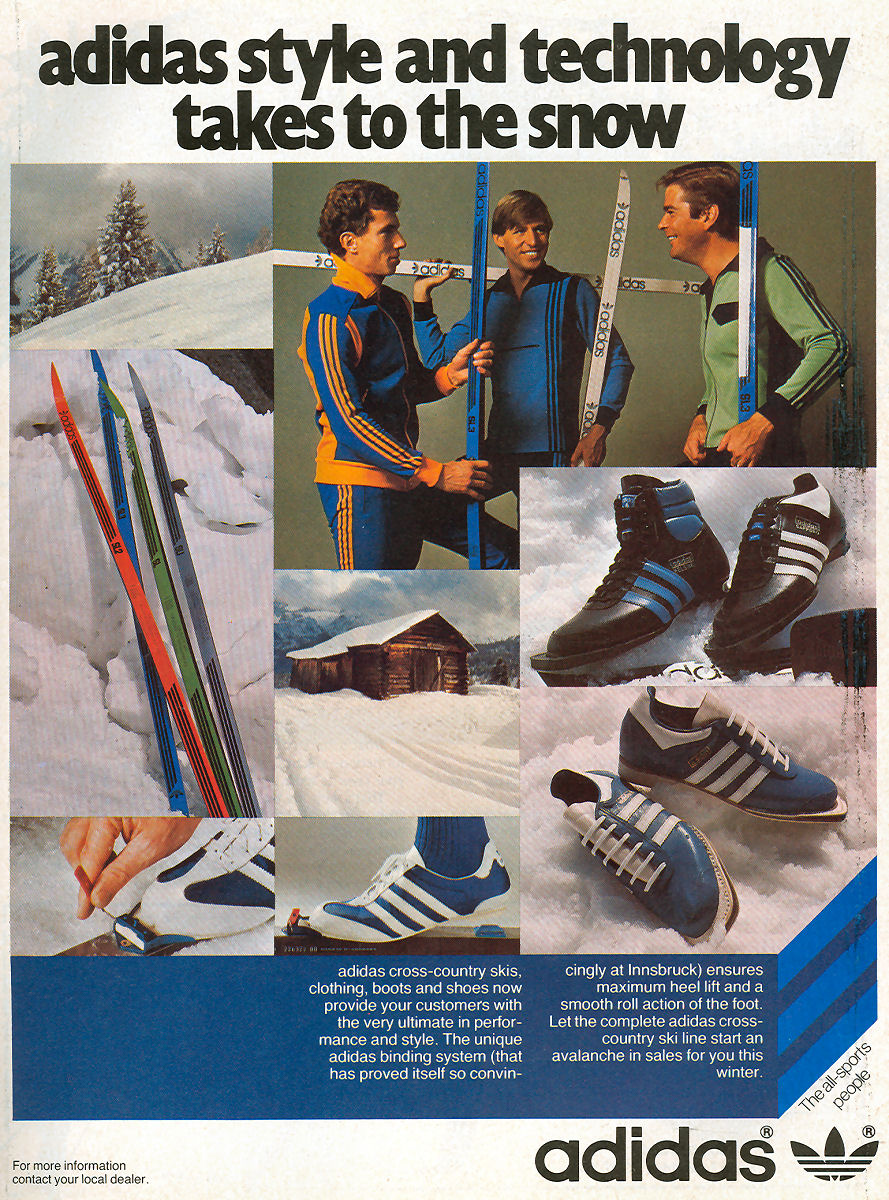
It's been a few months since the Nordic Commentary Project moved ahead, but with both winter and the World Cup just a few weeks away (though not necessarily in the same places), it's time to start posting again. I have a long piece in the works, but I thought I'd start off slow by linking to a fantastic collection of 1970s nordic-skiing ads like these. I love the color schemes!

Tuesday, June 28, 2011
Breaking the Melted Ice
It's been a while since a new post disturbed the serenity of this very seasonal blog, but I can't help sharing this cool video of Bjørgen and Johaug watching a replay of the World Champs 30k. Even if you can't understand what they're saying, their emotions come through.